
Get your grape vine spacing right and the vines more or less look after themselves — good airflow, even sun, room to work. Get it wrong and you spend every summer fighting mildew in a tangled hedge. After fifteen years of planting (and re-planting) cold-hardy vines up here in Wisconsin, here’s how I space mine, plus a planner that does the math for your yard (in feet or metres).
🍇 Backyard Vineyard Planner
Get vine count, trellis materials, a rough cost, and an estimated harvest.
The short answer
Space rows 8 ft (2.5 m) apart and vines 5–6 ft (1.5–1.8 m) apart within the row for a typical backyard planting of cold-hardy hybrids on a vertical trellis. Go a little wider (9 ft / 2.7 m rows) if you'll mow between them, a little tighter only if you're short on space and growing low-vigor varieties.
Spacing between rows
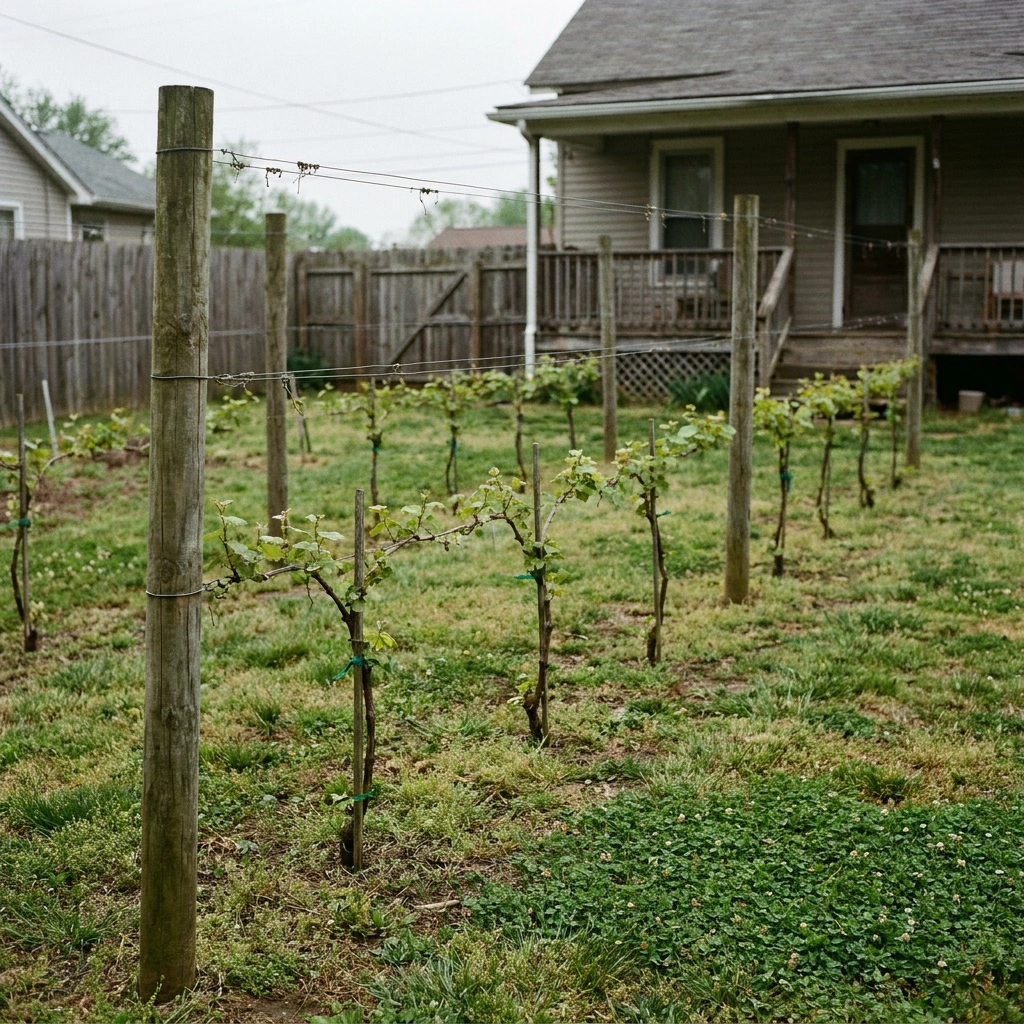
Row spacing has almost nothing to do with the vine itself — it's about sunlight, airflow, and room to work. You want enough gap that one row doesn't shade the next and air moves freely through the canopy (your best free defense against fungal disease). For hand-worked backyard rows, 8 ft (2.5 m) is a comfortable default; 6 ft (1.8 m) is the bare minimum on a 6 ft vertical trellis before shading and poor air circulation start causing problems.
Driving something between the rows? Add 3–4 ft (about 1 m) to the width of your mower or tractor so you can actually turn and work safely.
Spacing between vines
In-row spacing comes down to one thing: how vigorous your vine will be, which depends on your variety, soil, and climate. Rich, deep soil with lots of rain and heat grows a monster vine that needs 6–8 ft (1.8–2.4 m) of room. Leaner soil and a cooler, drier site — like most of the cold-climate north — means less vigor, so 5 ft (1.5 m), even 4 ft (1.2 m) for weak growers, is plenty.
The University of Minnesota's cold-hardy grape trials generally land on 5–6 ft (1.5–1.8 m) in-row spacing for hybrids like Marquette and Frontenac, which is what I use and what the planner above assumes. (For the full UMN recommendations, see their Growing grapes in the home garden guide — I lean on it constantly.)
Don't forget the planting hole — and the trellis goes in first
Dig the planting hole about 8 in (20 cm) wide by 8–12 in (20–30 cm) deep so the roots sit comfortably. If you've got a grafted vine, keep the graft union 2–4 in (5–10 cm) above the soil line. And build your trellis before you plant: trying to add posts and wire around established vines is a miserable job, and a year-one vine wants something to climb right away.
🍇 What I run: for the trellis I use 12.5-gauge high-tensile vineyard wire — it holds tension through a winter without sagging, unlike the cheap stuff. Here's the wire I buy on Amazon. For the vines themselves, start with named cold-hardy hybrids from a real nursery — Marquette and Frontenac starter vines are the easiest entry into a Zone 4 backyard vineyard.
Which way should the rows run?
If you can choose, run rows north–south so both sides of the canopy get even morning and afternoon sun. On a slope, running rows up-and-down a gentle south-facing slope also helps cold air drain away on frost nights — a real consideration where late spring frosts can nip young shoots.
Next steps
Once you've planned your spacing, the next jobs are building the trellis, preparing the soil, and getting your young vines trained in year one. I walk through each here:

You write: “Based on a 6′ tall trellis system, using a simple VPS (Vertical Positioning System), anything below 5′ between rows can cause one row to shade the next and also cause poor air circulation.” That’s the system I plan to use (first-time grape-grower, using Catawba grape cuttings from a friend). But my space is quite limited. Is it feasible to plant the rows any closer if I alternate the height of the cross-wires? Or would that actually block even more sun since the light is coming down at an angle?
Catawba grape cuttings are a good choice for a first-time grape-grower. They are known to be hardy and disease resistant.
The main concern with planting grapevines too close together is the lack of air circulation. Poor air circulation can lead to fungal diseases such as powdery mildew.
The VPS system is designed to allow for proper air circulation and prevent one row from shading the next, so it is not recommended to plant the rows any closer together. If you alternate the height of the cross-wires, you may be able to get away with planting the rows a little closer together, but it is not ideal.
It is always better to err on the side of caution when it comes to grapevines, so we would recommend following the guidelines for spacing set by the VPS system. This will give your grapevines the best chance to thrive.
Does spacing between vines effect the quantity of fruit per vine and the quality of the fruit. The closer together, the more competition between plant for moisture, nutrients etc. Versus the further apart you plant the vines in a row the more fruit per vine possible and the lower the quality. Consider 1.5 feet between plants versus 3 or 5 feet between plants in a row..
Grape growers often debate the best spacing distance for vines, and there are pros and cons to both 1.5-foot and 3- or 5-foot spacing.
There is some evidence that suggests spacing between vines can affect the quantity and quality of fruit produced. In general, vines should be spaced far enough apart so that all the vines in the row can receive adequate sunlight and irrigation. If vines are too close together, they may compete for resources and produce fewer and smaller fruit. Additionally, the quality of the fruit may suffer if the vines are not spaced properly.
With 1.5 feet between plants, you may get a higher yield of fruit per vine, but the quality of the fruit may not be as good as with wider spacing. With wider spacing, you’ll likely have fewer grapevines per row but the grapes will be larger and of better quality.
Ultimately, it is up to the grape grower to decide what spacing works best for their particular vineyard.
In my opinion, the spacing between vines does affect the quantity and quality of grapes. I believe that a grower would get fewer but larger and better quality grapes with wider spacing. I think that 1.5 feet between plants is too close and the vines will compete for resources resulting in smaller grapes.